#5 on the April 2014 A-to-Z Blog Challenge.
E: Eadha, Aspen in the Scottish Gaelic alphabet.
Aspens were the shield trees, because their lightweight wood (and possible magical properties) was favored for making them. A faery tree, it was forbidden to use their wood for farm implements or building, except for floors (thought to be slower to burn than other woods), or for fishing, although they were a favorite for paddles and oars.
 |
| Autumn Aspens |
The whispering of the leaves of this kind of trembling poplar tree often induced a meditative state, and it was believed that if you placed a leaf under your tongue, it'd bestow eloquence. Heroes wore crowns of them.
If you’re wondering why I’m not doing kelpies under K, there is no letter K in this alphabet. In Scottish Gaelic, the each-uisge [pronounced esk oos-geh] literally means “water horse,” considered the most dangerous faery water creature in the British Isles.
Imagine going along the shore of the sea or a loch, and seeing a black horse as beautiful as an Elven horse or a Mearh out of Tolkien’s Rohan. Once a kelpie looks you in the eyes, bespelling you, you can't resist going to it and climbing upon its back— then the glamor recedes, and you can see your danger as it races towards the water—but you can't get down; any part of you touching it adheres tightly. Only then can you see a red gleam in its eyes, and the flash of teeth, and know that it'll drown you and tear you apart for its meal underwater!
Why would people tell tales of such a fell creature? As a warning to be careful of strangers and things that look too good to be true, for one thing. In that kind of tale, the doomed person usually exclaims that it'll be a good working horse on the croft (marginal tenant farm) and as a stray, if he can catch it, its his.
There's one example, in Teresa Breslin’s The Illustrated Treasury of Scottish Folk & Fairy Tales, of a clever lad who, even though no man can tame a kelpie, prvents his family from starving by managing to put one to work.
The other reason is to tell how they can be overcome. In a revenge tale from Raasay, a blacksmith and his son set up a forge on the shore where their daughter/sister was taken, forge big hooks red-hot while roasting a sheep to lure the kelpie out of the loch, and then kill it with the hooks.
"Beware of strangers" covers the fact that these are also shape-shifters, and can appear as handsome black-haired men, generally when looking for dalliance. In that form, they’re very fond of lying with their heads in the maiden’s lap, having her comb its hair—and if she sees water-weed and/or sand, she may realize her danger.
A version from the Isle of Barra (my own favorite) tells of a lass knitting while minding her father’s sheep, when a kelpie arrives. She enlists her clever dog to bring her a magical bridle after lulling him to sleep, and forces him to work for her family for a year and a day in horse-shape. Every evening, she grooms him, telling him stories about her family and people. By the end of his term, they’ve fallen in love, he becomes human, and they wed.
There are kelpie songs, too. I combined “Cuighal nan Maighdin,” a spinning/knitting song from South Uist, and a Manx tune, “Arrane Ghelbee / Song of the Kelpie” with the Barra tale when I did a harptelling for a Scottish harp competition at the Ligonier Highland Games in the Spoken Word portion several years ago. The following week, I found two Scottish ones, a milking song from South Uist, and a Skye lullaby.
Dinna let a kelpie, in either form, lull you!
I'm in the midst of getting a long-overdue remodeling of my kitchen done! For a woman who's never been much of a cook or baker, this entire project has been a source of excitement, a great deal of careful thought, and some bemusement. I’ve been in many kitchens during my life, listening to other women complaining about the things they don’t like about their own, and have had plenty of time to decide what I want and don’t want in my own. My mother hated the big kitchen in our New Street house; she felt she should be borrowing my roller skates to speed things up instead of trudging from one part to another getting meals in that big room—until, a few years later, she was struggling in a very small kitchen into which the four of us barely fit. She succeeded in getting that one enlarged in her own remodeling (an epic tale in itself deserving a separate post), and I've been musing that hers took place during her 25th year of being married; coincidentally, so has mine.
I’m going to post about that later, when I can include pictures of the finished project.
Today is October 10th, and it is World Porridge Day. No, really!
Did you eat oatmeal porridge when you were little? Do you eat it now?
Granny and I did, when she wasn’t having shredded wheat. As a child, I ate it as a matter of course when she visited us, and/or in the winter. She was a purist, combining the oats, salt, and water in traditional Scottish fashion—although by then she was without her spurtle, making do with the biggest of the wooden spoons Grandpop had carved as a gift for Mother when she got married.
 |
| Oak & Cherry Spurtle |
A spurtle is a traditional Scottish cooking and baking implement. Obviously, the earliest stirrers humans used were simply sticks, over time being crafted and developed into spoons. A spurtle is a tapered stick, often now with a thistle-shaped top, most often used to stir porridge. I think the theory is that a sticky or stiff batter is less apt to clump on one due to the tapered design.
I’ve been wanting one for some time. The Ligonier Highland Games this year were memorable for unusual, steady, hard, daylong rain; my voluminous skirts wicked up at least three small puddles almost as soon as I got out of the car. After my storytelling at the carousel, I went over to the vendors’ area by the Big Field. Normally, the farthest edge past the last tents is a bit boggy, even on a hot, dry day. Vendors are set up in two rows of tents, one with its back to the field, the other in front of a copse of trees, down a slight grade. Intending to look at that row first, I took one step off the gravel…and sank up to my ankles in oozing mud! Chickening out, I headed upslope to Scottish Gourmet USA, and emerged after an interesting conversation about kitchens and blackboards with my very own spurtle, hand-carved by a man in Maine. I chose an oak and cherry one, and when I got home, put it in the Hickory, PA salt-glazed crock with my other prized wooden implements, next to my sprottle.
 |
| Sprottle |
What’s a sprottle? Another Scottish stirrer, kind of a cross between a spoon and a comma-shaped stick-end that has a hole in the middle. This is to beat air into a batter.
When I mentioned I was going to retire a year ago last August, several people asked me if I had any plans. Other than being John’s caregiver, and continuing to tell stories, play my Celtic harp, blog, and write, my plans were vague. Somewhat to my surprise, over the last 14 months, my list of projects has gotten longer, taking some unexpected turns, including the latest.
I want to bake.
As I mentioned, I’m not much of a cook or a baker. It amused me somewhat that as soon as my old oven died the week before last Christmas that this yen to bake became so pronounced. Ah, the attraction of the unattainable! That has solidified into a persistent desire to master baking various Scottish pastries, beginning with fern cakes—another post, as well!
And there are so many things one can bake with oatmeal….
Having a spurtle of my own meant, naturally, that I was going to look into these subjects of oatmeal and porridge more than I ever had before, and I found out some interesting things. Dr. Samuel Johnson famously defined oats in his Dictionary (1755) as: “A grain, which in England is generally given to horses, but in Scotland supports the people.”
He meant to be derisive, but was accurate; porridge of every kind has supported most peoples throughout the world for millennia. While we in the West tend to think of it as being made with oatmeal, porridges are made of many different grains all over the world, from the rice-based congee of Southeastern Asia, to the semolina and wheat kinds eaten in ancient Rome (frumenty, with fruit or meat added) and Finland to the cornmeal mush eaten by American pioneers (Laura Ingalls Wilder’s family ate it) to the potato-and-barley kinds eaten in Norway and Russia to varieties made with rye, quinoa, millet and sorghum in other places. Whatever grain is its base, it can be flavored with almost anything from fruit (berries, pieces or a spoonful of jam), nuts, spices, coconut, chocolate, butter, meat, fish, seafood, mushrooms, vegetables, milk or water, bread, eggs…the list goes on!
Did you ever play a clapping game, chanting or singing:
Pease porridge hot, pease porridge cold,
Pease porridge in the pot, nine days old;
Some like it hot, some like it cold,
Some like it in the pot, nine days old….
although it was unlikely to last that long! Yup, that’s another kind! Kind of greenish, I always thought it must be. I imagine that some porridges flavored with chocolate or cocoa, like the Tsampurado of the Phillippines, or the Champurrado drink of Mexico, must be brownish. The first time I had Italian polenta, fixed by my friend Betsy’s mom Elaine Ogden, it was bright yellow, and I suppose other kinds are various tints too. I’ve never had Shuco, which is a Salvadoran drink made with black, blue, or purple corn flour, ground pumpkin seeds, chili sauce, and some red cooked kidney beans, traditionally drunk out of a hollowed-out gourd in early morning, but doesn’t that sound colorful?
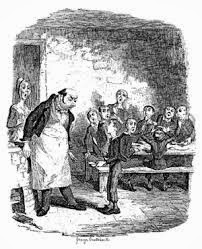
I did write drink—porridges can range from almost being as thick as a dumpling to gruel. The latter is defined as a "thin, watery porridge," not that manufacturers like Horlicks have wanted to mention the “g” term for the last 175 years. Ever since Dickens had Oliver Twist (1838) ask for more, please, in the workhouse, it’s been synonymous with parsimony and poverty…and that’s why that most miserly of all literary misers, Ebenezer Scrooge, was making some when Jacob Marley clomped in. Yet, indicative of gruel's place as a diet staple in many cultures, earlier in that century Jane Austen had her middle-class characters, as well as the poor, eating it for their health (Mr. Woodbridge, in Emma), and so did Emily Brontë. More recently, in one of his Belgariad fantasy trilogy, David Eddings has two characters of opposite opinions of it—Errand happily calls it porridge, but Silk despises it as gruel. If Frodo and Sam had not had the Elvish lembas, they would have sustained themselves with gruel—and I bet that’s one reason why the orcs were so quarrelsome in The Lord of the Rings!

My research led me to the website for the Porridge Lady, who had a post about the World Golden Sprottle Porridge Championship in Scotland, held last week. They are teaming up this year with Mary’s Meals, a non-profit that, for example, helps 600,000 children in Malawi get a mugful of Likuni Phala, a maize-based porridge. They have to go to school to get it, and for most of them, it’s the only nutritious meal a day they get. The children have to take care of their own mugs; some carry them on a string around their necks so they don’t lose them. If you go to those websites, you can easily donate.
Oatmeal is well-known to be nutritious and filling, but wouldn’t you like the way even a small donation to such a worthy cause would help fill up another part of you?


