
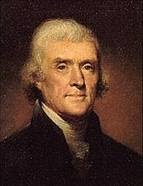
Thomas Jefferson is renowned for many things: the Declaration of Independence, minister to France during part of the Revolution, President, founder of the University of Virginia, inventor, scholar whose library formed the nucleus of the Library of Congress, gardener, architect….and, my father would add, introduced ice cream to America—although Wikipedia says that Benjamin Franklin, George Washington, and Dolly Madison all made and served ice cream to their guests.

Now why should I want to write a blog post about ice cream?
Because my mother, Dorothy Dangler Jacob, felt bored and restless as a 1950s homemaker, that’s why. One evening at supper when I was five, my mother said that after we finished, she’d be going out; she was starting a part-time job at Welsh Farms Dairy in Long Valley, NJ. My brother scowled; none of his friends’ mothers worked outside the home, but I was curious. “What will you do?” I asked.
“Milking the cows,” said Daddy, his eyes twinkling. “She’ll be a milk-maid.”


My acquaintance with cows being limited in those days to nursery rhymes like the cow jumping over the moon, that seemed pretty cool to me. Mother smiled. “No, I’m going to be answering the phone and helping with orders for the milkmen,” she said. “My job is called a Night Owl.”
Then Daddy explained that it meant she’d be driving over to Long Valley and back, that she’d leave after supper and get home very, very late—so if Mother decided to take a nap during the day, we’d have to be very quiet so she could sleep. Unfortunately, she was not capable of napping, so she spent years being sleep-deprived.
“And,” she added, “I’ll get part of my wages in dairy products—milk, cream, and ice cream.”

WOW! A perpetual, unlimited supply of ice cream….
“I don’t like ice cream!” grumbled my brother. One more piece of evidence of his being a changeling, I thought.
As she would for more than 40 years, Mother kissed us, picked up a large brown wicker basket and her purse, and went out to the car. She had to clock in by seven pm. Daddy began clearing the table.
Mother didn’t really have a burning desire to work at night, or to spend hours talking on the phone. She did want the extra money it would bring in, to use for things like piano and dance lessons for me, and most of all, for us to take vacation trips in the summer, fulfilling her yearning to travel. I can understand that; I inherited my itchy feet from her. A part-time job at night was a good fit, because we could still have supper together, only had one car and Daddy could be home with us in the evenings. I enjoyed his putting me to bed, and later he would help me with my homework; I think it made the two of us closer.
At the time, Welsh Farms was one of many small local dairies. The buildings were an assortment of dark green shingled structures that had been added to over the years, and I must have been about 10 or 11 when they bought a split-level house to function as the office building.
 |
| Long Valley bridge from Raritan River |
Mother would drive over Schooley’s Mountain, down into Long Valley, turning left before the old stone bridge, bump over the railroad tracks, pass a ruined church on the left and the local volunteer fire department on the right, stop at the loading dock to pick up the sheets and tickets she would work on, and then drive further to the office. At the front desk in the deserted reception area, she’d answer phones as the route managers and dealers called in their orders. They were supposed to do this before midnight, but often she would have to call them. On big forms, the sheets, she would carefully note down what items needed to be loaded onto the big trucks that would be driven by the route managers from the loading dock to various distribution points, where the drivers (milkmen) would meet them to get their individual tickets listing what went into each man’s load: half-pints, pints, quarts, half-gallons, gallons, and larger amounts of milk, half-and-half, heavy cream, butter, ice cream, sherbet, ice cream mix (for some stores and restaurants), along with the products. Later they expanded into orange juice, cottage cheese, and novelty items such as pitchers, mugs and tumblers. Their clientele included individual families, stores, restaurants, and schools.
Her job required her to be precise and accurate in legibly listing all the products, making sure that the amounts and prices were accurate between the sheets and tickets, as well as ensuring that the right amounts of the right things got onto the right trucks—and to her annoyance, often some drivers would call her back and change the orders. Since each form was a layered sandwich of papers and three or four carbons, this often meant she had to completely redo everything. This was why she sometimes didn’t leave work until after 2 am, and if it was bad weather, she would have to inch her way up over the mountain, sometimes getting home as late as after 4. She never failed to make the trip home, even when it meant going to the upper side of the hairpin curve (on the wrong side of the road) just above Long Valley by the big
Welcome to Long Valley, NJ,
Home of Welsh Farms Dairy
billboard.
I think it was sometime in the early 70s that she was taken on fulltime and switched to daytimes. She enjoyed not being the only one there, although she told me that in many ways, working nights had given her a pipeline into the gossip mill; the other woman who worked in that job for years was the biggest gossip in the township and beyond, related to half the inhabitants and knew all the rest. “Men gossip more than women do!” she told me, “Most of them don’t listen much; they think I’m her and just rattle on about their conquests!” She gave up trying to convince some of them that she wasn’t Mildred, and just listened, never passing on anything she was told. After all, we lived in Hackettstown and didn’t even know many of those in Long Valley, Middle Valley, Califon, Fairmont, and Oldwick, and she really wasn’t interested.
I was more interested in the ice cream portion of her wages. We always got whatever the Flavor of the Month was, and sometimes she would indulge in an extra small round canister of a second flavor—but not very often. Usually that would be in the fall, when Dad’s and my favorite was made in limited quantities: Dutch Apple, subtly flavored with cinnamon and with big chunks of apple in it. Mmmmmmm!
 |
| Milk Bottle--note space at top for cream to rise. |
I was in Kindergarten at Budd Lake Elementary School when Mother arranged for my class to go on a field trip to the dairy. It was exciting to see the plant, and I remember the clinking sound as the glass bottles moved around on conveyers after being filled, to being capped and then put in big refrigerators.
When I had to get my tonsils out when I was six, Mother promised me we’d have plenty of vanilla fudge for my sore throat, and we did.
We were possibly the only family in Hackettstown that didn’t have an aluminum Welsh Farms Dairy milk box on our back stoop for the local dealer to put in the milk and get a note from the housewife as to what the family would need the next day or week. In the 60s, they dairy changed over to cartons, and I think it was in that decade or the next that the ice cream plant was moved to Caldwell. Gradually people got their milk at the grocery or convenience stores, instead of having it delivered.

By the time I was in college, the Port Murray dairy, the last other local one I knew about, was gone, and Welsh Farms was well on its way to becoming the largest dairy in northern New Jersey. It was after my freshman year that I learned I’d have to sit out a semester for lack of money to go back. I came home determined to get a job, worked for just under a week at the munitions factory (see my post on Memorial Day for that story), and when Daddy made me quit, Mother came to my rescue. Welsh Farms was opening what they hoped would be the first restaurant, the Welsh Farms Country Shops, at Panther Valley Mall outside town the next week. Once Mr. Thall, the manager, interviewed me, I was hired as a waitress.
I went in the next Thursday for training. Of the fifteen or so, all of us were high school or college girls without any experience, except for Rita, a woman in her 40s, and Gerri, also in her 40s. We all listened intently as we were told how to use the coffeemaker, saw where things were kept, and learned how to make malts, milkshakes, sundaes, spade ice cream and sherbet for hand-packaging, scoop for dishes and cones, and take and serve orders. Besides the ice cream, they served appetizers, soup, sandwiches, salads, and entrees. The most expensive item was a steak. Minimum wage was $1.45 an hour, and we could get a free meal on our shift up to that amount.
The next day, equipped with a white dress, white nurses’ shoes, a hair net, a stupid little gold sateen cap and a matching apron that contained 2 big pockets for my order pad and pen, I reported for work. It was our Grand Opening, and for that day, they had invited all the local merchants for a free lunch….And they all came, from miles around.
 |
| The Welsh Supreme was bigger! |
To my relief, instead of being assigned to the dining-room or one of the three bays surrounded by counter stools and 4-person booths, my station was the last bay, with eight stools and 3 big booths that seated 6 people at a time. That relief was short-lived; the middle booth was occupied by the dairy’s president and vice-presidents, most of whom I knew, all of them knowing Mother for years—and five of them decided that it’d be fun to tease me. So, after I served them meal platters with all the different substitutions they wanted, led by George Wack, they ordered the single largest and most difficult-to-make dessert: the Welsh Supreme. This concoction consisted of two large bananas as the foundation for eight scoops of ice cream (and they insisted on eight different flavors), with three different syrups, topped by mounds of whipped cream, five maraschino cherries, and chopped nuts.
It was some time before I returned with the dish—and six spoons. “What took you so long?” asked Mr. Wack.
“I hurt my wrist on the chocolate,” I said; they could see that it was somewhat red and swollen. “It was much harder to scoop than the other flavors.”
Mr. Wack jumped up right away to go check, and told me later that the freezer compartments containing the big 15-gallon canisters of ice cream had all been set at the same temperatures. The chocolate, because it had the highest percentage of fat, needed to be slightly higher; the sherbets, with the most sugar, needed to be at lower temps.
I enjoyed being a waitress. Most of the time, I was on the first station, which had 12 counter stools, the take-out counter, all the hand-packed orders, and the cash register. Because I was usually there, I thought it was fair that we had tip cans, because most of the larger tips were left in the dining-room—and counter customers who just stopped in for coffee, a sandwich , or a dish of ice cream, usually left tips of a quarter or even just a dime. Another of my duties was training newer girls, but I was completely defeated by an older woman named Muriel. She was very anxious to please, but incredibly nervous and forgetful. After three weeks, I still had to remind her what went into a setup—a place-mat (with the menu printed on it), napkin, knife, fork and spoon, and a glass of iced water. One day I went into the walk-in freezer off the kitchen, where most of the refrigerated supplies were kept. I didn’t stop there, however, because I needed to replace a 15-gallon container of Chocolate Chip Mint, and went through the heavy door into the deep freeze. Suddenly the door slammed behind me. Both it and the outer one were locked, with no interior latches!
Out front, some time later, Mr. Thall emerged from his office and noticed that customers were stacking up by the register. He rang up their checks, and turned to Muriel, who was carefully filling the condiment holders with mustard, pickles and ketchup. “Where’s Barra?” he asked.
“Oh, she’s here somewhere,” she said vaguely.
He had another girl check the ladies’ room, asked Jack the cook. Bobby Stewart, the busboy, said, “I saw her go into the walk-in just before Muriel did. Muriel came out, and then Jack sent me back to the dishwasher.”
By the time Mr. Thall jerked open the freezer door, I was turning blue and doing calisthenics as fast as I could. I was out for almost a week with bronchitis, and never saw Muriel again. When I got back to work, they had installed latches and a new rule: no one was to go into that room unless they were wearing Mr. Thall’s big parka. On me, it almost came down to the floor!
Two funny things come to mind from that period: every week or so, a big burly guy in a flannel shirt and jeans would come in with his tiny, frail, white-haired mother, who looked almost as transparent as a withered leaf. They would order a small scoop of vanilla ice cream and a Welsh Supreme banana split…and it was the fragile little old lady who’d devour the banana split, while her son usually ate only a few spoonfuls of his much smaller portion.

Then there was the time I was called in on a holiday weekend when we were unexpectedly short-staffed, and set to managing the ten tables in the dining-room by myself. A family came in with two boys for dinner. The older one was a brat; nothing satisfied him. Finally he decided on a big chocolate fudge sundae for dessert; I made it, brought it to him, and he insisted he had asked me for strawberry instead of chocolate ice cream. I went back to make another one, but didn’t notice that Bobby had dripped some water on the floor before he had a chance to mop it up. A rapidly-moving waitress stepping on wet tile floor might as well be wearing roller skates. I landed on my rump, keeping hold of the sundae dish—but the whipped cream and cherry flew up in the air and landed on my head like a clown’s hat before sliding down over my glasses….so once again, I made another and after cleaning myself up, delivered it to the customer. My tip was five bucks.
I worked there until mid-January, and again the next two summers. My family ate there for years, especially after they moved up to Panther Valley, even after it was sold and the name changed to first, the Eatery, and then BLDs (for Breakfast, Lunch and Dinner) Grille & Restaurant. The food was always good no matter how the décor changed. The ice cream was superb.
After I finished college and graduate school, and got married, Mother was still working at the dairy. Every nice day at lunchtime, she’d walk 20 minutes up a country road, sit on a wall and read for another 20 minutes while she ate, then walked briskly back. She kept postponing retirement, because she was having so much fun with the computers, and enjoyed training younger women—who would then be sent to another department. Finally, when she did retire in 1995, she surprised everyone by admitting that she was 85. They’d all thought she was much younger. She had worked there for 44 years.
At the Country Shops, I remember a woman customer who’d come in every week, ask for a strawberry malt, and then complain that we could never make it to her satisfaction. Once Rita chatted with her, and elicited the information that when she was a little girl, the woman’s father had had an ice cream parlor where he used to make her strawberry malts. “Well, no wonder we can’t get it right for you,” Rita said. “You’re tasting it with your memories of that time with your daddy. What can live up to that?”
Alas, Welsh Farms is no longer. I will never have Dutch Apple in the fall again, or vanilla fudge, or peppermint stick, or raspberry sherbet, or any of their other flavors at any other times. But I do have a round platter with the logo on it of the little boy in the green checked shirt and red striped pants, leading a red-and-white calf, given to Mother on one of her anniversaries, somewhere there is a little notebook of handmade cartoons I made, and I can still taste the flavors with my memories.

Notes:
- Dad's joke that first night turned into her CB handle, "Milk Maid" during the 70s. Daddy was "Red Hawk," and my sister was "Chickadee."
- Pictures of Welsh Farms Dairy items are from the collection of the Washington Township Historical Society in Long Valley. Their website has a nice slideshow of part of their collection.
- Picture of Long Valley bridge courtesy of Jason Koesterblatt, Long Valley Patch.


